Ashgabat: The White Marble City with More Guinness Records Than Any Other Capital
Ashgabat holds more Guinness World Records than any other capital city. This guide covers all 12 certified records, the buildings behind them, and what visitors actually see when they walk the white marble boulevards.
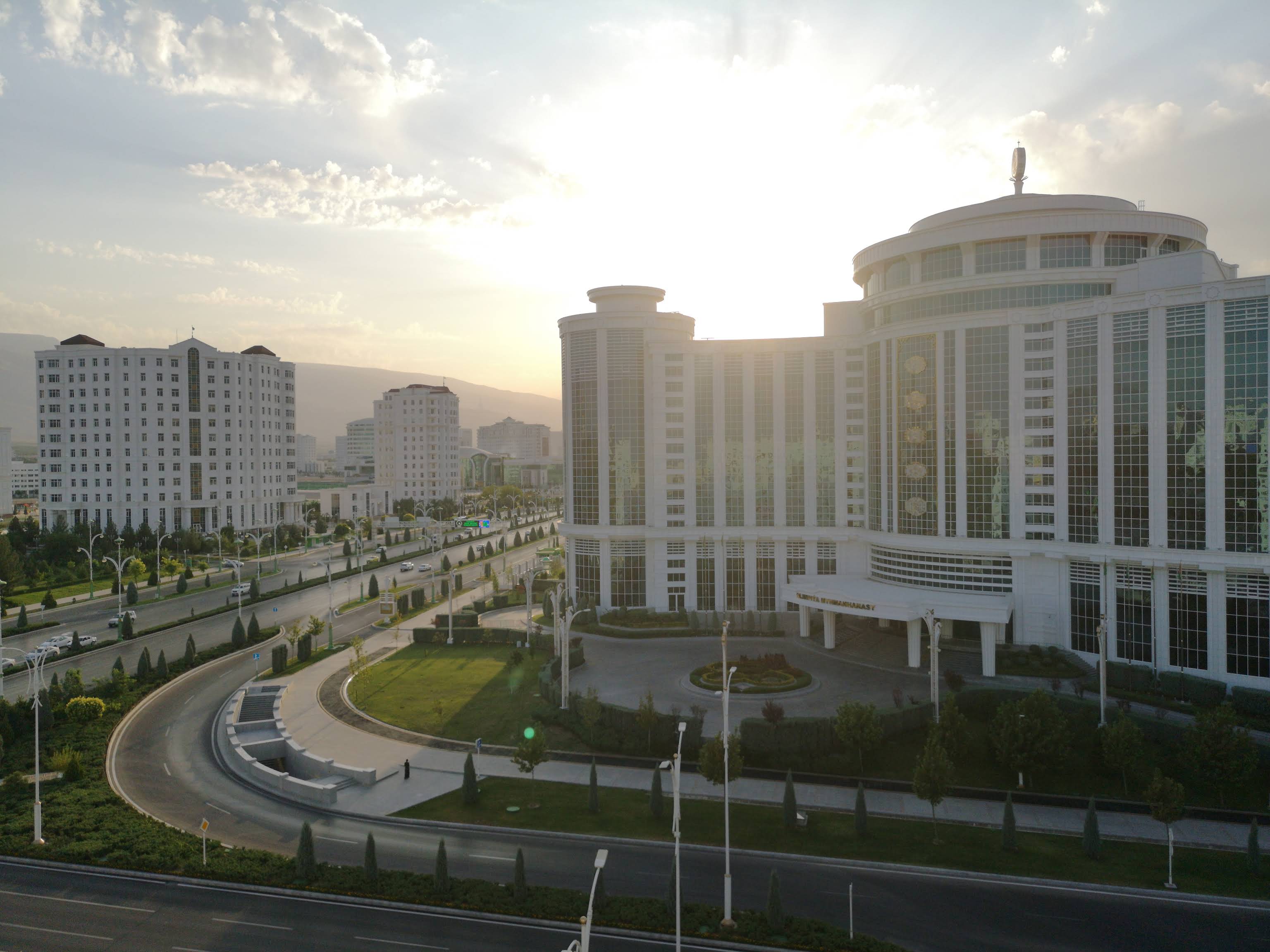
Ashgabat is the world's only capital known as a marble city, and Turkmenistan's marble city holds more Guinness World Records than any other capital in the world. All of them were certified after 1991. Not one is for ancient ruins or natural wonders: they cover things the government commissioned, organised, or built. A record for the density of marble buildings. A record for an indoor Ferris wheel. A record for fountain pools. Understanding what Ashgabat chose to have certified is the fastest way to understand what kind of place it is.
The white marble record
In 2013, Ashgabat received a Guinness World Record for the highest density of white marble-clad buildings in the world. The main avenue, Bitarap Türkmenistan Sayolu, runs 12.6 kilometres through the city and is lined with 170 white marble buildings along that stretch alone. The total number of certified buildings was in the hundreds at the time of measurement; construction has continued at pace since.
![[IMAGE: Ashgabat white marble city - Bitarap Türkmenistan Sayolu avenue lined with white government buildings on both sides]](https://pb.visitturkmenistan.today/_/../api/files/pbc_3607937828/37mnx1tkpj7cm20/birarap_15tmokox6x.jpeg)
The buildings are concrete structures clad in white marble panels, not solid stone. The marble comes primarily from quarries in the Karakala region. At street level the effect is the same: the city reflects sunlight with unusual intensity and photographs tend to blow out if you do not compensate.
The rebuilding began under President Niyazov in the 1990s, after independence, and accelerated under President Berdimuhamedow. Soviet-era apartment blocks were cleared and replaced with the white towers visible today. The process is still ongoing in the outer districts.
One visible side effect: all private cars registered in Ashgabat are required to be white. The rule has been in force since the early 2000s and is enforced by traffic police.
Every Guinness record in the city
Largest architectural star
The Turkmenistan TV Tower in central Ashgabat is topped by the largest architectural star ever certified by Guinness. The star structure measures 3,240 square metres and is clad in glass. The record was set in October 2011. The Oguz Khan star is the national emblem of Turkmenistan; the 31-floor tower that houses it is the tallest structure in the country and visible from most of the city.
Largest indoor Ferris wheel
The Alem Cultural and Entertainment Center received a Guinness record at its opening on 18 May 2012 for the world's largest Ferris wheel in an enclosed space. The wheel stands 47.60 metres (156 ft 2 in) high, with a diameter of 57 metres, and has 24 cabins. From outside, the building that houses it resembles a white five-pointed star.
Most fountain pools in a public place
Ashgabat holds the record for the most fountain pools in a public place: 27 pools covering 14.8 hectares. The fountains are coordinated, programmable, and synchronised with lighting. They run continuously during daylight hours throughout the warm months and are illuminated at night.
![[IMAGE: lit fountains in central Ashgabat at dusk, with white marble buildings in the background]](https://pb.visitturkmenistan.today/_/../api/files/pbc_3607937828/26cg14hsmdo2ikd/ashgabat_fountain_oi8scditm9.jpeg)
Largest bronze bas-relief
A bronze bas-relief depicting horses, the national symbol of Turkmenistan, was certified in October 2014 as the world's largest. It measures 117.84 square metres. The Akhal-Teke horse is central to Turkmen identity: it appears on the national emblem, and Horse Day is a public holiday observed each April.
Largest gul
Ashgabat International Airport, rebuilt in 2016 in the shape of a falcon in flight, holds a Guinness record for the largest gul at 705 square metres. A gul is the geometric medallion motif found on Turkmen carpets; the national flag's green stripe incorporates one. The airport's terminal floor carries a gul measured and certified on 11 September 2016.
Largest horse head sculpture
The Ashgabat Olympic Stadium is topped by a horse head sculpture certified in March 2017 as the world's largest. It stands 40.05 metres tall, measures 37.69 metres in length, and 40.24 metres across at its widest. The Akhal-Teke breed it depicts is native to Turkmenistan and considered one of the oldest horse breeds in the world.
Largest aquatics sports park
The Ashgabat Olympic Complex also holds the record for the largest aquatics sports park, with 4,976.65 square metres of pools certified in April 2016. The complex was built for the 2017 Asian Indoor and Martial Arts Games, which Ashgabat hosted.
Records beyond the architecture
Not every Guinness record Turkmenistan holds is for a building. Several come from government-organised mass events, which form a distinct pattern of their own.
In June 2018, 3,246 participants took part in the world's largest cycling awareness lesson in Ashgabat. The following year, 1,995 participants formed the longest single-line bicycle parade in the same city on the same date, 1 June 2019. Both records were organised by the government. President Berdimuhamedow is an avid cyclist and has promoted cycling as a national pastime, with new cycling infrastructure built across Ashgabat in the 2010s.
In June 2018, the President's own Akhal-Teke horse, named Akhan, ran 10 metres on its hind legs in 4.19 seconds, setting a Guinness World Record for the fastest 10 metres on hind legs by a horse. The attempt took place in Ashgabat.
In 2015, 4,166 participants in the city of Mary set the record for most people singing in a round. In August 2019, 2,935 participants in Turkmenbashi set the record for the largest ecology lesson. These events follow a recognisable format: a large number of citizens, organised by the state, participate in an activity long enough to be timed and counted.
Outside the capital, Turkmenistan also holds the Guinness record for the longest-burning methane crater: the Darvaza Gas Crater, known as the Door to Hell, has been alight in the Karakum Desert since 1971. It measures 69 metres across and 30 metres deep. Most itineraries include a stop there en route between Ashgabat and the Uzbekistan border.
What visitors actually see
Walking in central Ashgabat is a specific experience. The boulevards are wide and have few pedestrians relative to their scale. Traffic is light. The fountains run. The ratio of monumental space to human presence is unlike most capitals.
The record-holding sites are close together. The TV Tower and its star are visible from much of the central city. The Alem Center is a short drive away. The Olympic Complex, with the horse head and the aquatics park, is to the west. The airport's gul is visible before you leave the terminal.
For visitors on a private Turkmenistan tour, Ashgabat typically gets a half-day or full day. The standard route covers the main marble boulevard, the TV Tower area, the Carpet Museum, and the Russian Bazaar. The Ashgabat travel guide covers the logistics: which sites are accessible, how to get around, where to eat, and what to expect from the streets.
Visiting on a tour
All visitors to Turkmenistan require a visa and a Letter of Invitation (LOI) issued by a licensed operator. We handle both as part of every booking. Ashgabat is included in most itineraries as the starting point or the first full day of the trip, and the Guinness-certified sites are all within the city limits.
Our private tour packages include a guided visit to Ashgabat's main record-holding sites. We also run fixed-date group tours and most of these also include an Ashgabat city tour.